🎉 Up to 70% Off Selected ItemsShop Sale
1 / 6
+1
Kwakwaka'Wakw Thunderbird Button Robe
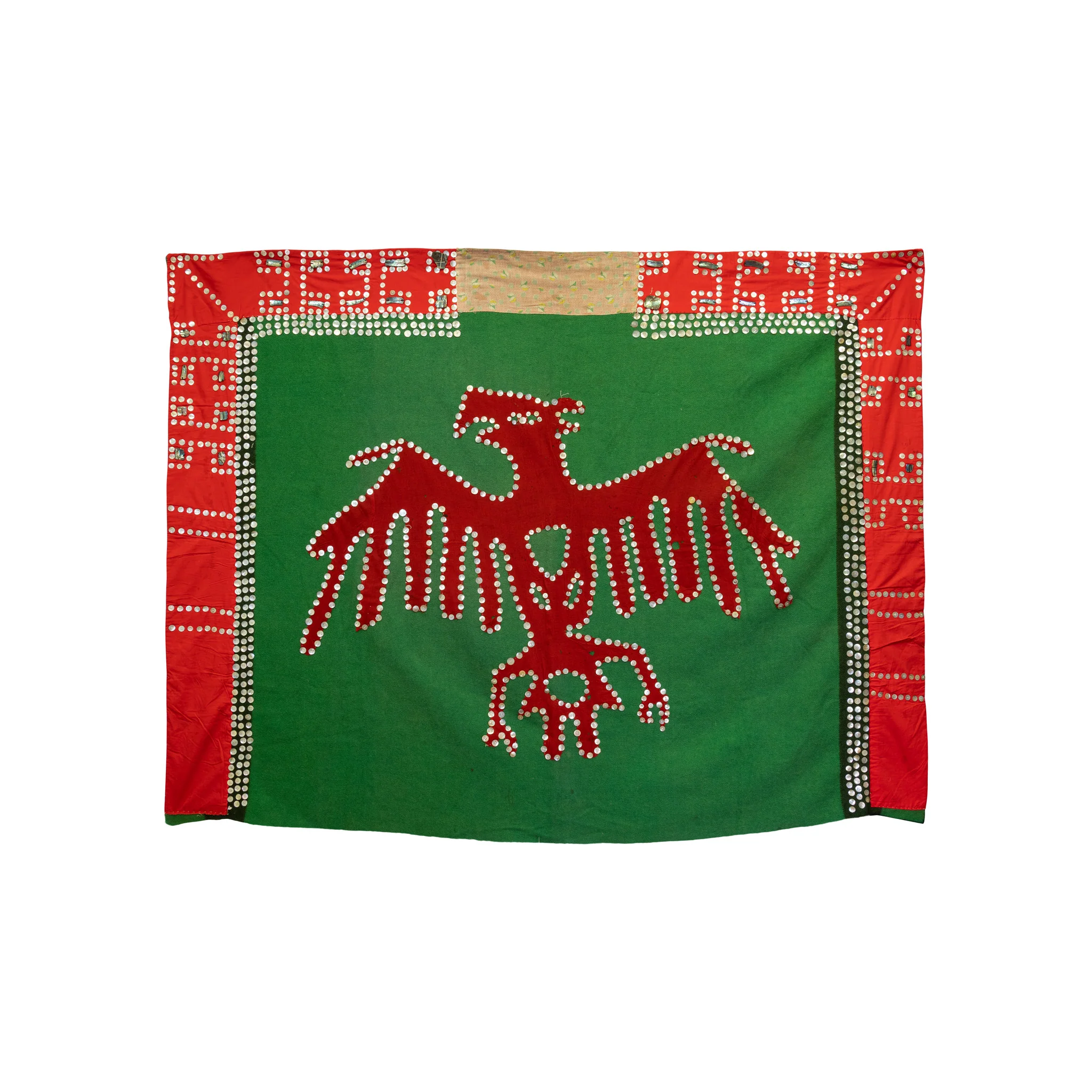
Vintage Northwest Coast Kwakwaka'Wakw button robe featuring thunderbird. 56" x 75"
Button blankets are worn in ceremony and for other formal occasions by Northwest Coast Indigenous peoples, from the Coast Salish peoples in Washington State to the Tlingit people in Southeastern Alaska. The button blanket, which is worn as a robe around the shoulders, was a 19th century innovation using woolen trade blankets and mother-of-pearl buttons and abalone shells.
Button blankets are constructed through an applique technique that overlays a cutout crest image (often red cloth), over a dark blue or black ground cloth, which is in turn framed on three sides (left, right, and top) with a border that is the same color as the applique crest image.
The image and the borders are outlined with mother of pearl or abalone buttons, giving the regalia its name. Some of the most elaborate button blankets can be found among the Kwakwaka’wakw people of the Central Coast of British Columbia and adjacent Vancouver Island.
This older, early 20th century example is almost certainly from the Kwakwaka’wakw people, based on the elaborate button design scheme, the red and green cloth that’s used, and the Thunderbird depicted in the center.
This robe has over 1000 buttons and features extensive elaborations, such as the “negative cross” design created in the negative spaces of the mother-of-pearl buttons and abalone shells on the red border, and the three rows of buttons along the inside edge of the border.
The skeletal formline Thunderbird aligns with designs found on older Kwakwaka’wakw button blankets, and the materials themselves – old, green, Hudson Bay woolen blanket; thin, likely Asian-made shell buttons; and the red trade cloth used for the border – speak to the antiquity of this piece. The worn linen patch at the top center of the blanket also alludes to its age and usage.
PERIOD: 19th Century
ORIGIN: Northwest Coast - Unknown, Native American
SIZE: 56" x 75"
Vintage Northwest Coast Kwakwaka'Wakw button robe featuring thunderbird. 56" x 75"
Button blankets are worn in ceremony and for other formal occasions by Northwest Coast Indigenous peoples, from the Coast Salish peoples in Washington State to the Tlingit people in Southeastern Alaska. The button blanket, which is worn as a robe around the shoulders, was a 19th century innovation using woolen trade blankets and mother-of-pearl buttons and abalone shells.
Button blankets are constructed through an applique technique that overlays a cutout crest image (often red cloth), over a dark blue or black ground cloth, which is in turn framed on three sides (left, right, and top) with a border that is the same color as the applique crest image.
The image and the borders are outlined with mother of pearl or abalone buttons, giving the regalia its name. Some of the most elaborate button blankets can be found among the Kwakwaka’wakw people of the Central Coast of British Columbia and adjacent Vancouver Island.
This older, early 20th century example is almost certainly from the Kwakwaka’wakw people, based on the elaborate button design scheme, the red and green cloth that’s used, and the Thunderbird depicted in the center.
This robe has over 1000 buttons and features extensive elaborations, such as the “negative cross” design created in the negative spaces of the mother-of-pearl buttons and abalone shells on the red border, and the three rows of buttons along the inside edge of the border.
The skeletal formline Thunderbird aligns with designs found on older Kwakwaka’wakw button blankets, and the materials themselves – old, green, Hudson Bay woolen blanket; thin, likely Asian-made shell buttons; and the red trade cloth used for the border – speak to the antiquity of this piece. The worn linen patch at the top center of the blanket also alludes to its age and usage.
PERIOD: 19th Century
ORIGIN: Northwest Coast - Unknown, Native American
SIZE: 56" x 75"
$3,150.00
Original: $9,000.00
-65%Kwakwaka'Wakw Thunderbird Button Robe—
$9,000.00
$3,150.00Description
Vintage Northwest Coast Kwakwaka'Wakw button robe featuring thunderbird. 56" x 75"
Button blankets are worn in ceremony and for other formal occasions by Northwest Coast Indigenous peoples, from the Coast Salish peoples in Washington State to the Tlingit people in Southeastern Alaska. The button blanket, which is worn as a robe around the shoulders, was a 19th century innovation using woolen trade blankets and mother-of-pearl buttons and abalone shells.
Button blankets are constructed through an applique technique that overlays a cutout crest image (often red cloth), over a dark blue or black ground cloth, which is in turn framed on three sides (left, right, and top) with a border that is the same color as the applique crest image.
The image and the borders are outlined with mother of pearl or abalone buttons, giving the regalia its name. Some of the most elaborate button blankets can be found among the Kwakwaka’wakw people of the Central Coast of British Columbia and adjacent Vancouver Island.
This older, early 20th century example is almost certainly from the Kwakwaka’wakw people, based on the elaborate button design scheme, the red and green cloth that’s used, and the Thunderbird depicted in the center.
This robe has over 1000 buttons and features extensive elaborations, such as the “negative cross” design created in the negative spaces of the mother-of-pearl buttons and abalone shells on the red border, and the three rows of buttons along the inside edge of the border.
The skeletal formline Thunderbird aligns with designs found on older Kwakwaka’wakw button blankets, and the materials themselves – old, green, Hudson Bay woolen blanket; thin, likely Asian-made shell buttons; and the red trade cloth used for the border – speak to the antiquity of this piece. The worn linen patch at the top center of the blanket also alludes to its age and usage.
PERIOD: 19th Century
ORIGIN: Northwest Coast - Unknown, Native American
SIZE: 56" x 75"