🎉 Up to 70% Off Selected ItemsShop Sale
1 / 4
Northwest Coast Killer Whale Button Blanket
Northwest Coast button blanket - style killer whale wall hanging. 37" x 41"
Button Blankets originated in the early 19th century on the Northwest Coast of North America, an early innovation that used trade blankets to create a beautiful and flashy new type of regalia. They are constructed using an applique technique that overlays a cutout crest image, often in red, over a dark blue or black woolen ground cloth. The crest image is then framed by a cloth border, often in the same color as the crest, and outlined with mother of pearl or abalone buttons. Over the last two centuries, button blankets have become an iconic emblem of the Northwest Coast.
Because of the strong iconographic imagery of button blankets, they have also been adapted as textile wall hangings, such as this example. The presence of five dowel hoops sewn into the top of this textile confirms that it was created as a decorative wall panel and not a ceremonial object or regalia. Even so, the construction and craftsmanship are virtually identical between this textile panel and a button blanket that was intended for usage.
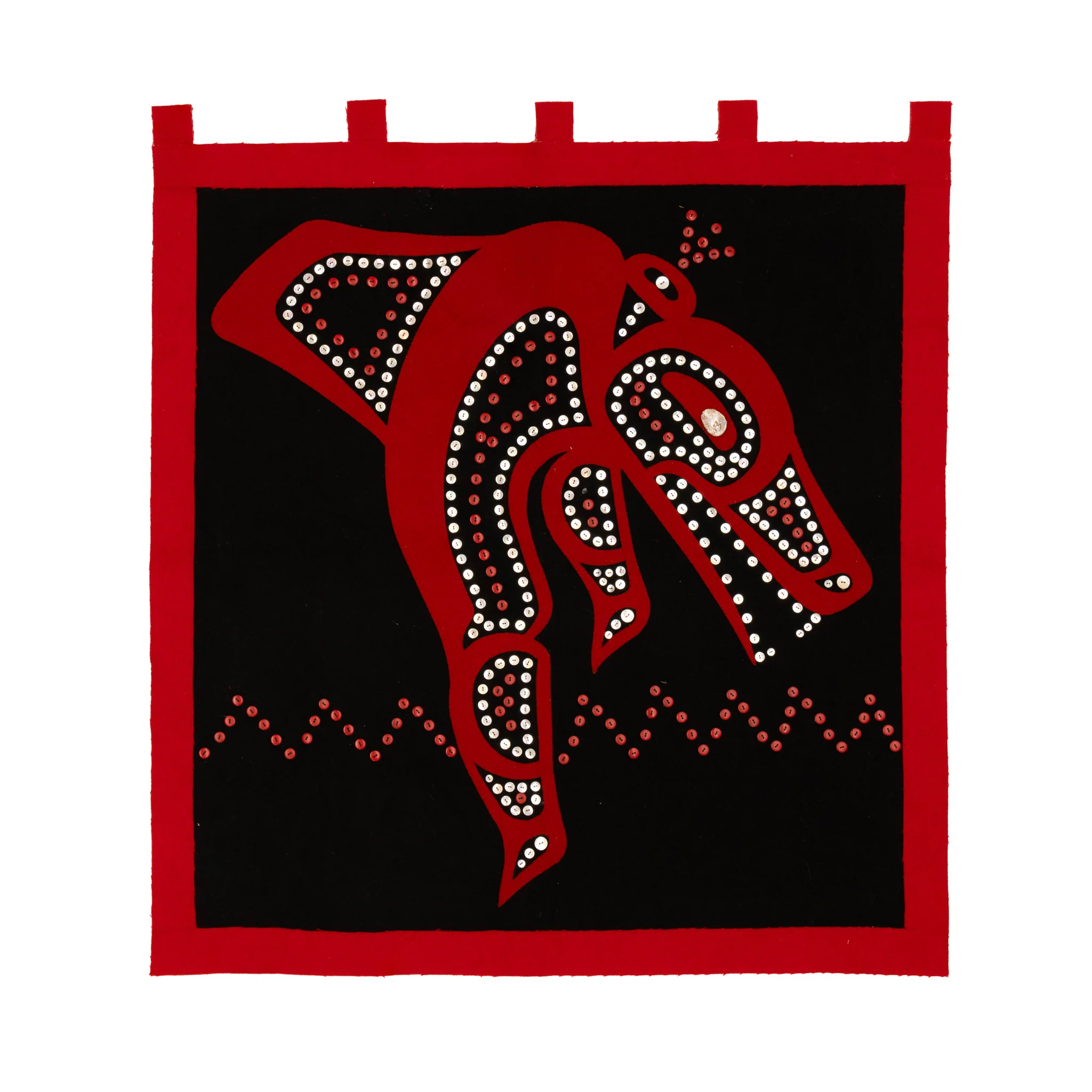
This textile features a formline Killer Whale cut out of red cloth and appliqued to a black background. The Killer Whale crest’s primary forms are outlined in white buttons, with its secondary forms and tertiary space outlined and filled with red buttons. The saw-tooth pattern representing waves and the Killer Whale’s spray are also represented in red buttons. The Killer Whale’s eye is represented by a large, natural abalone shell.
PERIOD: Contemporary
ORIGIN: Northwest, United States
SIZE: 37” x 41”
Northwest Coast button blanket - style killer whale wall hanging. 37" x 41"
Button Blankets originated in the early 19th century on the Northwest Coast of North America, an early innovation that used trade blankets to create a beautiful and flashy new type of regalia. They are constructed using an applique technique that overlays a cutout crest image, often in red, over a dark blue or black woolen ground cloth. The crest image is then framed by a cloth border, often in the same color as the crest, and outlined with mother of pearl or abalone buttons. Over the last two centuries, button blankets have become an iconic emblem of the Northwest Coast.
Because of the strong iconographic imagery of button blankets, they have also been adapted as textile wall hangings, such as this example. The presence of five dowel hoops sewn into the top of this textile confirms that it was created as a decorative wall panel and not a ceremonial object or regalia. Even so, the construction and craftsmanship are virtually identical between this textile panel and a button blanket that was intended for usage.
This textile features a formline Killer Whale cut out of red cloth and appliqued to a black background. The Killer Whale crest’s primary forms are outlined in white buttons, with its secondary forms and tertiary space outlined and filled with red buttons. The saw-tooth pattern representing waves and the Killer Whale’s spray are also represented in red buttons. The Killer Whale’s eye is represented by a large, natural abalone shell.
PERIOD: Contemporary
ORIGIN: Northwest, United States
SIZE: 37” x 41”
$4,500.00
Northwest Coast Killer Whale Button Blanket—
$4,500.00
Description
Northwest Coast button blanket - style killer whale wall hanging. 37" x 41"
Button Blankets originated in the early 19th century on the Northwest Coast of North America, an early innovation that used trade blankets to create a beautiful and flashy new type of regalia. They are constructed using an applique technique that overlays a cutout crest image, often in red, over a dark blue or black woolen ground cloth. The crest image is then framed by a cloth border, often in the same color as the crest, and outlined with mother of pearl or abalone buttons. Over the last two centuries, button blankets have become an iconic emblem of the Northwest Coast.
Because of the strong iconographic imagery of button blankets, they have also been adapted as textile wall hangings, such as this example. The presence of five dowel hoops sewn into the top of this textile confirms that it was created as a decorative wall panel and not a ceremonial object or regalia. Even so, the construction and craftsmanship are virtually identical between this textile panel and a button blanket that was intended for usage.
This textile features a formline Killer Whale cut out of red cloth and appliqued to a black background. The Killer Whale crest’s primary forms are outlined in white buttons, with its secondary forms and tertiary space outlined and filled with red buttons. The saw-tooth pattern representing waves and the Killer Whale’s spray are also represented in red buttons. The Killer Whale’s eye is represented by a large, natural abalone shell.
PERIOD: Contemporary
ORIGIN: Northwest, United States
SIZE: 37” x 41”