🎉 Up to 70% Off Selected ItemsShop Sale
1 / 5
Pair of Haida Totem Poles
Pair of Northwest Coast (Haida) totem poles, circa 1900. Although the identity of this maker is currently unknown, it is likely that they were a Kaigani Haida artist from Prince of Wales Island in Southeastern Alaska.
This attribution is based on a pole by this same hand that was signed with the name “Yeltatzie,” a highly specific Kaigani Haida surname. The poles by this maker also subtly taper toward their tops, are painted with Native pigments, exhibit heavy patinas, and feature hollowed-out backs that point to a late-19th or early 20th century creation and align with other poles from this era.
That all said, this artist had a deeply idiosyncratic style whose eyes had strong pinching in their corners and a signature “overbite” that gave the faces of his figures a distinctive look. This artist also used a distinctive horizontal “U-form” at the tops of the wings of the bird figures, where other makers would have used an ovoid.
The poles by this maker were often carved in alder and very deeply carved. All of this is to say, this maker was eccentric in their execution, but the model poles they made were of a very high quality. This pair of poles date to around 1900-1910 and were almost certainly made and purchased at that time.
It’s a bit astonishing that these poles have remained together all these years through various owners and being traded in the art market. In recognition of this, the poles are only being offered as a pair.
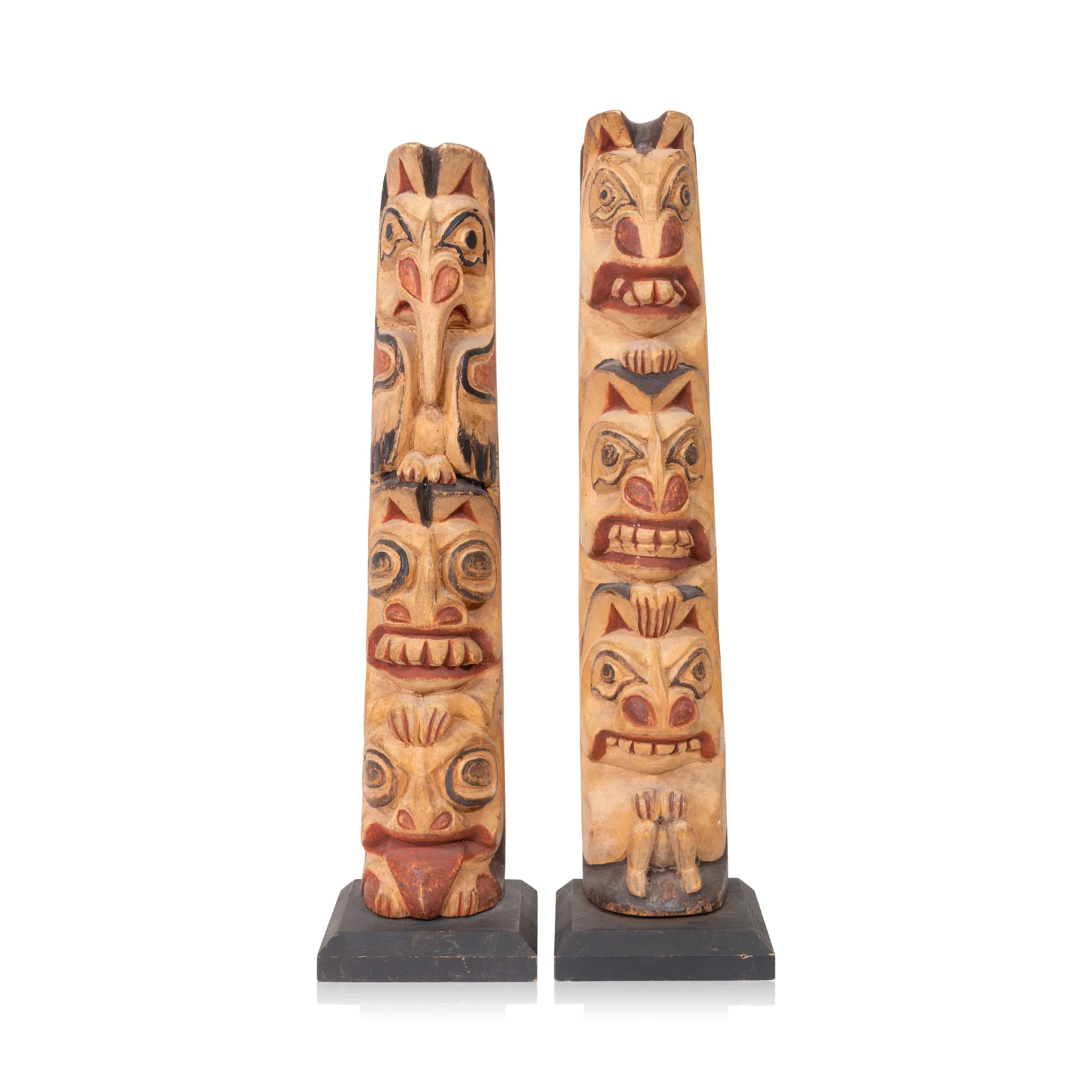
The slightly shorter pole on the left features, from top: Raven or Heron, the head and front legs of a Bear with a mouth full of teeth, and a Frog with an extended tongue at the bottom. Notably, the eyes of the Bear and Frog are well-formed ovoids.
The taller pole, on the right, features three variations of Bear figures with different expressions on their faces. The bottom figure is rendered with a full body, with its forepaws resting on its knees, sitting on top of a small black pedestal or dome.
Both poles are painted simply in red and black Native pigments and are mounted on chamfered bases. The backs of the poles are both hollowed out and are painted in the same red and black pigments. Priced as a pair. 13"
PERIOD: Early 20th Century
ORIGIN: Northwest Coast - Haida, Native American
SIZE: 13"
Pair of Northwest Coast (Haida) totem poles, circa 1900. Although the identity of this maker is currently unknown, it is likely that they were a Kaigani Haida artist from Prince of Wales Island in Southeastern Alaska.
This attribution is based on a pole by this same hand that was signed with the name “Yeltatzie,” a highly specific Kaigani Haida surname. The poles by this maker also subtly taper toward their tops, are painted with Native pigments, exhibit heavy patinas, and feature hollowed-out backs that point to a late-19th or early 20th century creation and align with other poles from this era.
That all said, this artist had a deeply idiosyncratic style whose eyes had strong pinching in their corners and a signature “overbite” that gave the faces of his figures a distinctive look. This artist also used a distinctive horizontal “U-form” at the tops of the wings of the bird figures, where other makers would have used an ovoid.
The poles by this maker were often carved in alder and very deeply carved. All of this is to say, this maker was eccentric in their execution, but the model poles they made were of a very high quality. This pair of poles date to around 1900-1910 and were almost certainly made and purchased at that time.
It’s a bit astonishing that these poles have remained together all these years through various owners and being traded in the art market. In recognition of this, the poles are only being offered as a pair.
The slightly shorter pole on the left features, from top: Raven or Heron, the head and front legs of a Bear with a mouth full of teeth, and a Frog with an extended tongue at the bottom. Notably, the eyes of the Bear and Frog are well-formed ovoids.
The taller pole, on the right, features three variations of Bear figures with different expressions on their faces. The bottom figure is rendered with a full body, with its forepaws resting on its knees, sitting on top of a small black pedestal or dome.
Both poles are painted simply in red and black Native pigments and are mounted on chamfered bases. The backs of the poles are both hollowed out and are painted in the same red and black pigments. Priced as a pair. 13"
PERIOD: Early 20th Century
ORIGIN: Northwest Coast - Haida, Native American
SIZE: 13"
$2,100.00
Original: $6,000.00
-65%Pair of Haida Totem Poles—
$6,000.00
$2,100.00Description
Pair of Northwest Coast (Haida) totem poles, circa 1900. Although the identity of this maker is currently unknown, it is likely that they were a Kaigani Haida artist from Prince of Wales Island in Southeastern Alaska.
This attribution is based on a pole by this same hand that was signed with the name “Yeltatzie,” a highly specific Kaigani Haida surname. The poles by this maker also subtly taper toward their tops, are painted with Native pigments, exhibit heavy patinas, and feature hollowed-out backs that point to a late-19th or early 20th century creation and align with other poles from this era.
That all said, this artist had a deeply idiosyncratic style whose eyes had strong pinching in their corners and a signature “overbite” that gave the faces of his figures a distinctive look. This artist also used a distinctive horizontal “U-form” at the tops of the wings of the bird figures, where other makers would have used an ovoid.
The poles by this maker were often carved in alder and very deeply carved. All of this is to say, this maker was eccentric in their execution, but the model poles they made were of a very high quality. This pair of poles date to around 1900-1910 and were almost certainly made and purchased at that time.
It’s a bit astonishing that these poles have remained together all these years through various owners and being traded in the art market. In recognition of this, the poles are only being offered as a pair.
The slightly shorter pole on the left features, from top: Raven or Heron, the head and front legs of a Bear with a mouth full of teeth, and a Frog with an extended tongue at the bottom. Notably, the eyes of the Bear and Frog are well-formed ovoids.
The taller pole, on the right, features three variations of Bear figures with different expressions on their faces. The bottom figure is rendered with a full body, with its forepaws resting on its knees, sitting on top of a small black pedestal or dome.
Both poles are painted simply in red and black Native pigments and are mounted on chamfered bases. The backs of the poles are both hollowed out and are painted in the same red and black pigments. Priced as a pair. 13"
PERIOD: Early 20th Century
ORIGIN: Northwest Coast - Haida, Native American
SIZE: 13"