🎉 Up to 70% Off Selected ItemsShop Sale
1 / 5
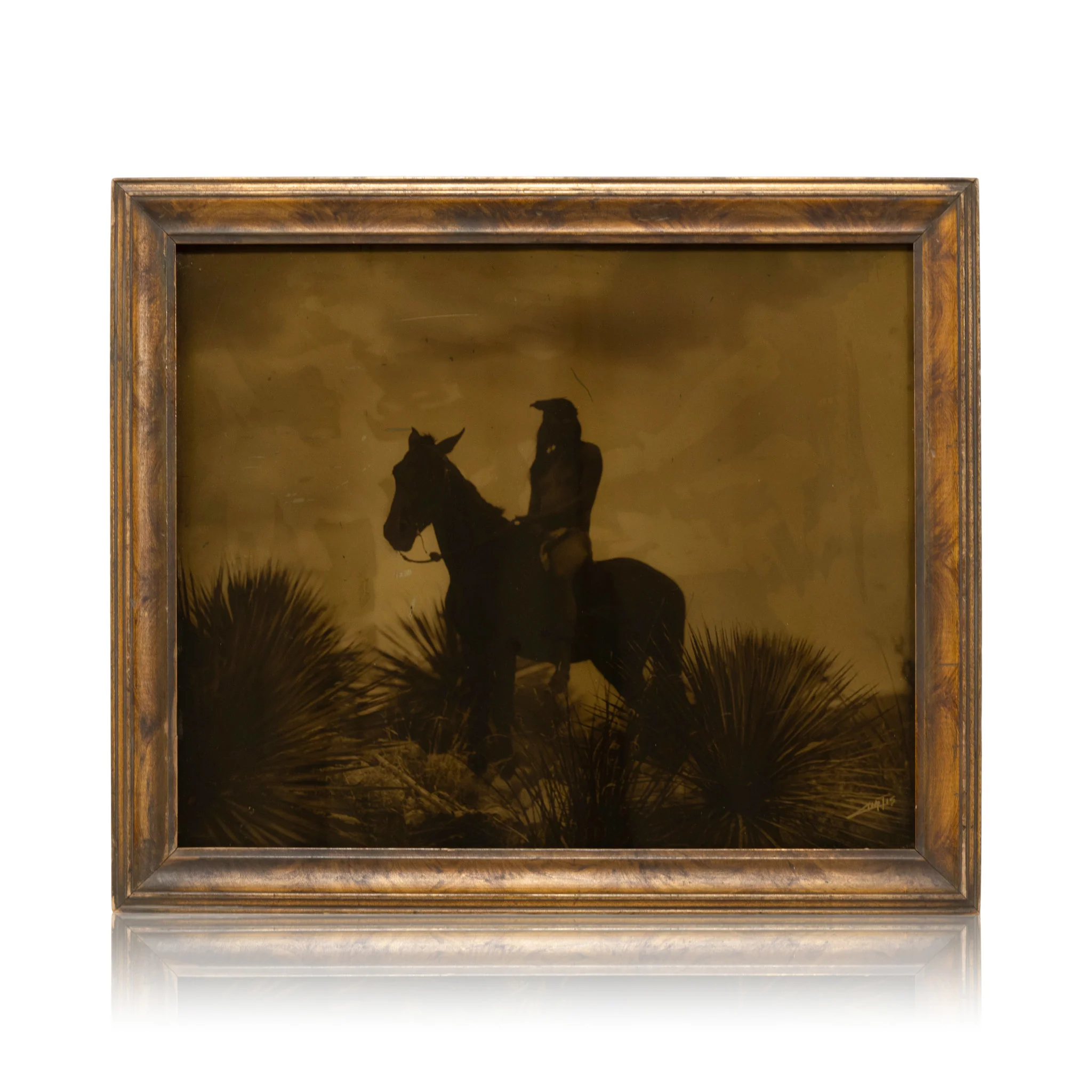
"The Scout - Apache" by Edward Sheriff Curtis
(1868-1952) 1906 Orotone photograph on glass plate. Signed in negative lower right. 14" x 17" frame 16 1/2" x 20"
Edward Sheriff Curtis (1868-1952) was one of this country’s preeminent photographers and created a body of work that is absolutely unparallel in the history of photography and ethnography. Curtis was a pioneer of the Goldtone (or orotone) process and its most ardent proponent. He wrote of the process: The ordinary photographic print, however good, lacks depth, lacks transparency, or more strictly speaking, lacks translucency.
We all know how beautiful the stone and pebbles are in a limpid brook of the forest where the water absorbs the blue of the sky and the green of the foliage. Yet when we take the same iridescent pebbles from the water and dry them they are dull and lifeless. So it is with the orthodox photographic print, but in the orotone all the translucency is retained, and they are as full of life and sparkle as an opal.
Curtis Centennial Project has itself pioneered many new techniques and processes in producing its Goldtones and is now, after over three years of experimentation, able to produce Goldtones that are unparalleled in their beauty, consistency and archival stability.
PERIOD: Early 20th Century
ORIGIN: California, United States
SIZE: 14" x 17" frame 16 1/2" x 20"
(1868-1952) 1906 Orotone photograph on glass plate. Signed in negative lower right. 14" x 17" frame 16 1/2" x 20"
Edward Sheriff Curtis (1868-1952) was one of this country’s preeminent photographers and created a body of work that is absolutely unparallel in the history of photography and ethnography. Curtis was a pioneer of the Goldtone (or orotone) process and its most ardent proponent. He wrote of the process: The ordinary photographic print, however good, lacks depth, lacks transparency, or more strictly speaking, lacks translucency.
We all know how beautiful the stone and pebbles are in a limpid brook of the forest where the water absorbs the blue of the sky and the green of the foliage. Yet when we take the same iridescent pebbles from the water and dry them they are dull and lifeless. So it is with the orthodox photographic print, but in the orotone all the translucency is retained, and they are as full of life and sparkle as an opal.
Curtis Centennial Project has itself pioneered many new techniques and processes in producing its Goldtones and is now, after over three years of experimentation, able to produce Goldtones that are unparalleled in their beauty, consistency and archival stability.
PERIOD: Early 20th Century
ORIGIN: California, United States
SIZE: 14" x 17" frame 16 1/2" x 20"
$4,200.00
Original: $12,000.00
-65%"The Scout - Apache" by Edward Sheriff Curtis—
$12,000.00
$4,200.00Description
(1868-1952) 1906 Orotone photograph on glass plate. Signed in negative lower right. 14" x 17" frame 16 1/2" x 20"
Edward Sheriff Curtis (1868-1952) was one of this country’s preeminent photographers and created a body of work that is absolutely unparallel in the history of photography and ethnography. Curtis was a pioneer of the Goldtone (or orotone) process and its most ardent proponent. He wrote of the process: The ordinary photographic print, however good, lacks depth, lacks transparency, or more strictly speaking, lacks translucency.
We all know how beautiful the stone and pebbles are in a limpid brook of the forest where the water absorbs the blue of the sky and the green of the foliage. Yet when we take the same iridescent pebbles from the water and dry them they are dull and lifeless. So it is with the orthodox photographic print, but in the orotone all the translucency is retained, and they are as full of life and sparkle as an opal.
Curtis Centennial Project has itself pioneered many new techniques and processes in producing its Goldtones and is now, after over three years of experimentation, able to produce Goldtones that are unparalleled in their beauty, consistency and archival stability.
PERIOD: Early 20th Century
ORIGIN: California, United States
SIZE: 14" x 17" frame 16 1/2" x 20"